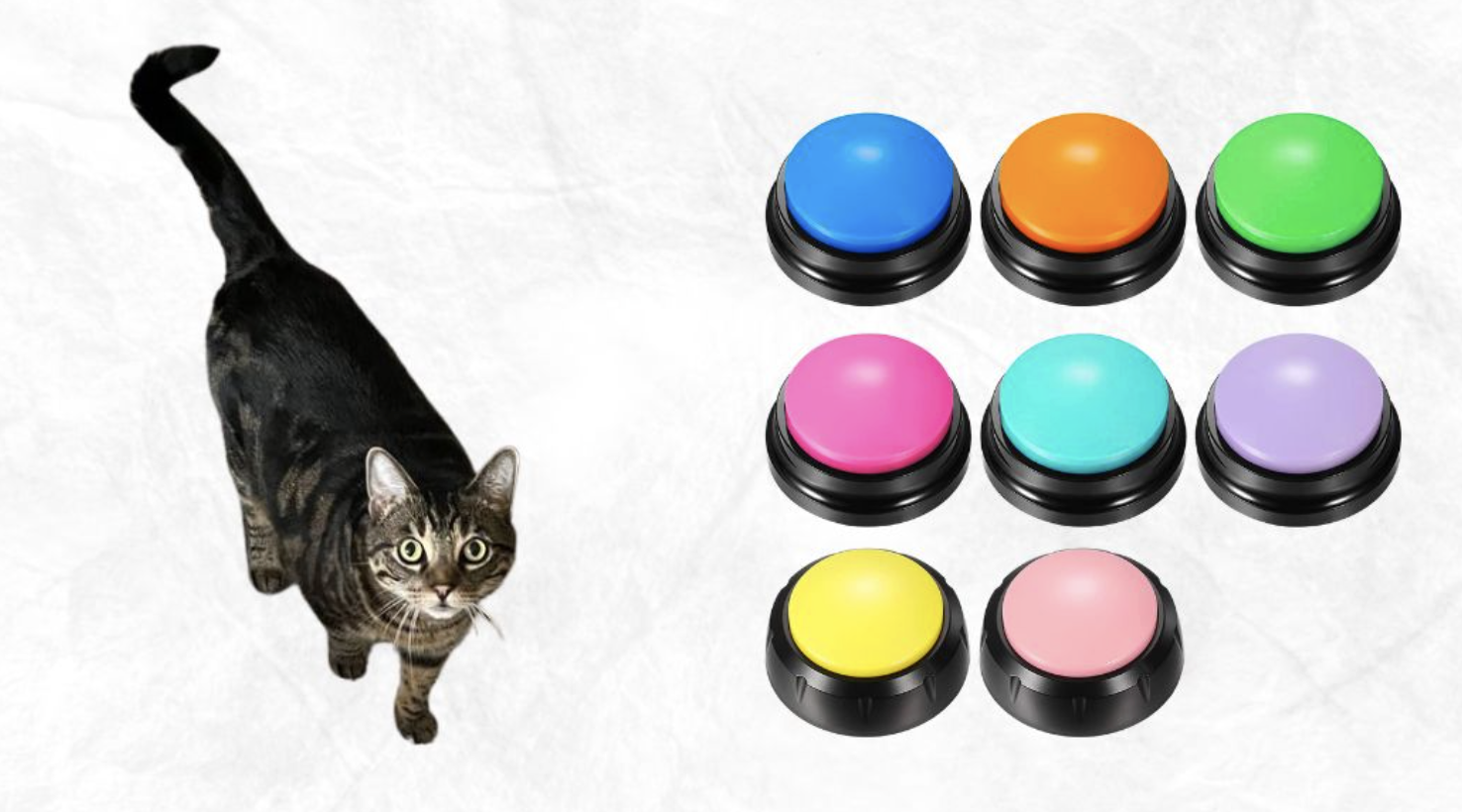
Can Cats Really Talk With Buttons? 60-Day AAC Training Experiment + Step-by-Step Guide
Can cats really use talking buttons? I tested AAC button training with my cat for 60 days. Here’s what worked, what failed, and how to train your cat step-by-step.
Written by MyPetsDesign Team
Pet care enthusiasts & community contributors
Have you ever stared at your cat, listening to a complex series of meows, and felt like a complete idiot? You go through the checklist: Are you hungry? Is the water dirty?
You try everything.
Food bowl check.
Water refreshed.
Toy thrown.
Still meowing.
Why I Started Button Training My Cat
Then you see those viral videos. Cats tapping buttons that say “food,” “pets,” even “I love you.” The internet declares a linguistic breakthrough. Humans cry. Cats press plastic. Civilization advances.
Or does it?
I decided to find out.
This is the story of my two-year-old Siamese mix, Luna, twelve buttons, sixty days of structured training, and what I honestly believe about whether cats can truly communicate using AAC buttons.
AAC stands for Augmentative and Alternative Communication. In the pet world, it usually means recordable sound buttons that play words when pressed.
I just needed her to stop "shouting" and start "pointing." I bought the buttons as a desperate peace treaty: "I will give you what you want, if you just stop making me guess." I wanted to replace the chaotic noise with clear, data-driven communication. I wanted a remote control for my cat’s brain—or at the very least, a way to get a full night's sleep.
Month 1: Building the First Word
Week 1: Pure Association
First word: “Treat.”
Step one was not teaching meaning.
It was teaching cause and effect.
-
I placed a high-value treat directly on top of the button.
-
When Luna touched it, the button activated.
-
The sound played.
-
She immediately received the treat.
At this stage she wasn’t “pressing.” She was accidentally triggering sound while chasing food. That’s fine. We were building the loop:
Button sound = Reward.
Short sessions. Five minutes. Multiple times per day. No pressure.
Week 2: Guided Paw Placement
I removed the treat from the button surface.
-
I gently guided her paw onto the button.
-
The sound played.
-
Immediate treat.
Timing was everything. The reward had to arrive within seconds. Delay weakens the association.
By the end of week two, she began placing her paw on the button voluntarily… but only when she saw the treats in my hand.
Still motivation-driven. Still external.
Week 3: Independent Pressing
Now I stopped guiding her paw.
I waited.
The first voluntary press felt like discovering fire.
She looked at the button.
Looked at me.
Pressed.
Reward.
From there, repetition built fluency. By the end of week three, she would press “Treat” when I walked past the board.
Was she saying “I want food”?
Or “This plastic makes snacks appear”?
Functionally, those are almost the same.
Week 4: Generalization
Once “Treat” became stable, I added “Brush.”
New rule:
Press “Brush” → immediate brushing session.
Press “Treat” → snack only.
No cross-rewarding. Clarity matters.
She learned “Brush” much faster than the first word. The learning curve shortens once they understand the system itself.
By day 30, she had four words:
-
Treat
-
Brush
-
Pets
-
Play
She used them correctly about 70 percent of the time.
That is not language.
But it is intentional signaling.
Month 2: Expanding Into Simple Combinations
This is where it gets interesting.
I introduced name buttons:
-
Luna
-
Dad
Then action buttons:
-
Come
-
Up
-
Play
Within two weeks, she began pressing:
“Dad + Come”
“Luna + Up”
Were these sentences?
Not exactly. There is no evidence she understands grammar.
But she clearly understood sequence mattered.
The most surprising pattern: after using the litter box, she repeatedly pressed “Happy.” After brushing sessions, she pressed “Love you.”
Is that emotion?
Or just reinforcement history?
Hard to say. But it was consistent.
By day 60 she reliably used 12 buttons.
Meanwhile, my British Shorthair and Golden Chinchilla Persian watched this entire process and never pressed a single button voluntarily.
Individual variation is real.
So… Do Cats Actually Understand Words?
Let’s stay grounded.
Current research does not confirm that cats using AAC devices truly grasp symbolic language.
What they absolutely can learn is operant conditioning.
From a learning theory perspective, this resembles a biological version of a small-scale neural model, somewhat like a simplified neural network. Through repetition and feedback, associations strengthen over time, similar in spirit to optimization processes like gradient descent.
But learning a mapping is not the same as understanding syntax, time, or abstraction.
For example:
-
She does not understand “tomorrow.”
-
She does not grasp “later.”
-
She lives almost entirely in “now.”
What she understands is outcome probability.
Press → Result.
That alone can look astonishingly like language.
Step-by-Step Guide: How to Train Your Cat to Use Buttons
If you want to try AAC button training with your cat, here is a refined process based on my experience.
Step 1: Choose High-Value Reinforcers
Do not start with low-interest activities.
Use:
-
Favorite treats
-
Brushing if they love it
-
Play sessions
-
Door access
Motivation drives learning.
Step 2: Start With One Word Only
Record one clear word. Keep pronunciation consistent.
Examples:
-
“Treat”
-
“Outside”
-
“Play”
Do not teach multiple words at once. Avoid confusion.
Step 3: Build Immediate Cause-and-Effect
Press → Instant reward.
No delay. No negotiation. No maybe.
Consistency is the backbone of learning.
Step 4: Fade Physical Guidance
If you begin by guiding their paw, gradually reduce assistance.
Wait for independent pressing before rewarding.
Independence marks real progress.
Step 5: Attach Words to Real Events
Pair the button with the event every single time.
Before brushing, prompt the brush button.
Before opening a door, prompt the outside button.
Repetition cements association.
Step 6: Introduce New Words Slowly
Only add a new button when the previous one is stable for at least one week.
Expansion works best when the foundation is solid.
Step 7: Accept Imperfection
Your cat will:
-
Press the wrong button.
-
Press repeatedly.
-
Spam buttons at 5 a.m.
This is normal.
They are testing outcomes.
What I Learned After 60 Days
-
Not all cats will succeed. Motivation and personality matter more than breed.
-
Most cats will plateau at basic needs.
-
A small percentage may show impressive combination behavior.
-
It is communication.
-
It is not proven language.
The distinction matters.
But here is the part that surprised me most.
One evening, I was working late. Luna walked to the board.
She pressed:
“Dad”
“Come”
Then sat there staring at me.
Whether that was language, conditioning, or probability testing almost didn’t matter.
Because I came.
And she purred.
Plastic buttons did not create connection.
They amplified it.
And now every morning begins with button pressing and eye contact negotiations.
Silence is gone.
Communication, however you define it, is very much alive. 🐾
All articles on MyPetsDesign are created by our team and community contributors based on real pet care experiences.
Enjoy this article?
Complete this article to earn points!
Earn +50 points by completing this article.
Sign in to earn points when you complete articles.
Must-have Picks


Comments
Recommended Reading
- 10 Things Dog Parents Should Know About Potty Training5 min read
- Dog buttons are recordable buttons that let your dog 'talk' to you. 5 min read
- Ableism in Pet Dog Training: Recognizing and Overcoming Biases in Training Methods6 min read
- Unintended Barriers in Positive Reinforcement Dog Training: A Guide to Accessible Methods6 min read
- 3 Common Dog Training Mistakes That Sabotage Your Progress4 min read